The moment you pick up a photography book and turn the first page, something happens that a screen can never give you; photography flows not at your speed, but with your speed. Building a photography book collection has been rediscovered in recent years — not as a nostalgia movement, but as the most serious method of deepening visual thinking. In this article, we will talk about why the printed photography book is still valuable, how a collection is built, and what this practice truly means.
What a Photography Book Is and Is Not
Not every book that contains photographs is a photography book. Yearbooks, calendars, promotional catalogues… these are printed materials in which photographs are used as tools. A photography book, on the other hand, is a work in which photography itself is the subject — one that makes a claim.
The fundamental building blocks of a photography book are: sequence (the order and rhythm of the photographs), edit (which photographs make it in and which are left out), page layout, and print quality. When these four elements are correctly constructed together, what emerges is not simply "a book containing beautiful photographs" but a holistic experience that builds a layer of meaning no single photograph could carry on its own.
Henri Cartier-Bresson's The Decisive Moment (1952), Robert Frank's The Americans (1958), Daido Moriyama's Farewell Photography (1972)… the reason these books are still consulted today is not the beauty of the photographs they contain, but how those photographs speak to one another.
The Sequence Problem That Screens Cannot Solve
Digital galleries, Instagram profiles, Behance portfolios… they all share a common problem: they cannot control the viewer's pace. On a screen, you scroll, you get bored, you switch to another tab. In a photography book, the page is a cut; it is the conscious decision of an editor who controls what comes before and after.
This difference may seem small; its consequences are significant.
When two photographs appear side by side or one after another in a book, a third meaning forms between them. This is often called the "diptych effect" or the production of meaning through sequence. A single frame that looks ordinary on its own can carry an entirely different weight when placed alongside the frame before and the frame after. Constructing this relationship in a digital environment is technically possible, but nearly impossible in an experience controlled by the viewer's scrolling gesture.
Photographers - especially those working in documentary and artistic photography — still see the book format as the platform where the work is taken seriously, precisely for this reason.
The Oldest Method of Visual Education
Reading photography books is the most direct way to develop visual literacy.
You can go to a photography school, memorize light diagrams, perform histogram analysis — all of that gives you technical knowledge. But training your eye — that is, answering the question "why does this work, why doesn't this work" by feel — requires a different kind of practice: exposure to a large quantity of good photographs, and staying slowly with those photographs.
The photography book is an unparalleled tool for this second kind of practice. You can hold a page for two minutes and look. You can go back. You can compare two photographs. You can see how the light falls, how the framing works, the nuances in tone — on paper, independent of screen brightness.
Many photographers and art directors manage their reference libraries not with digital folders but with printed books. The practical meaning of this is: in a work conversation or a brief meeting, you put the book on the table, open the page, and say "this is what I want." It is a far more powerful form of communication than showing 300 photographs on a screen.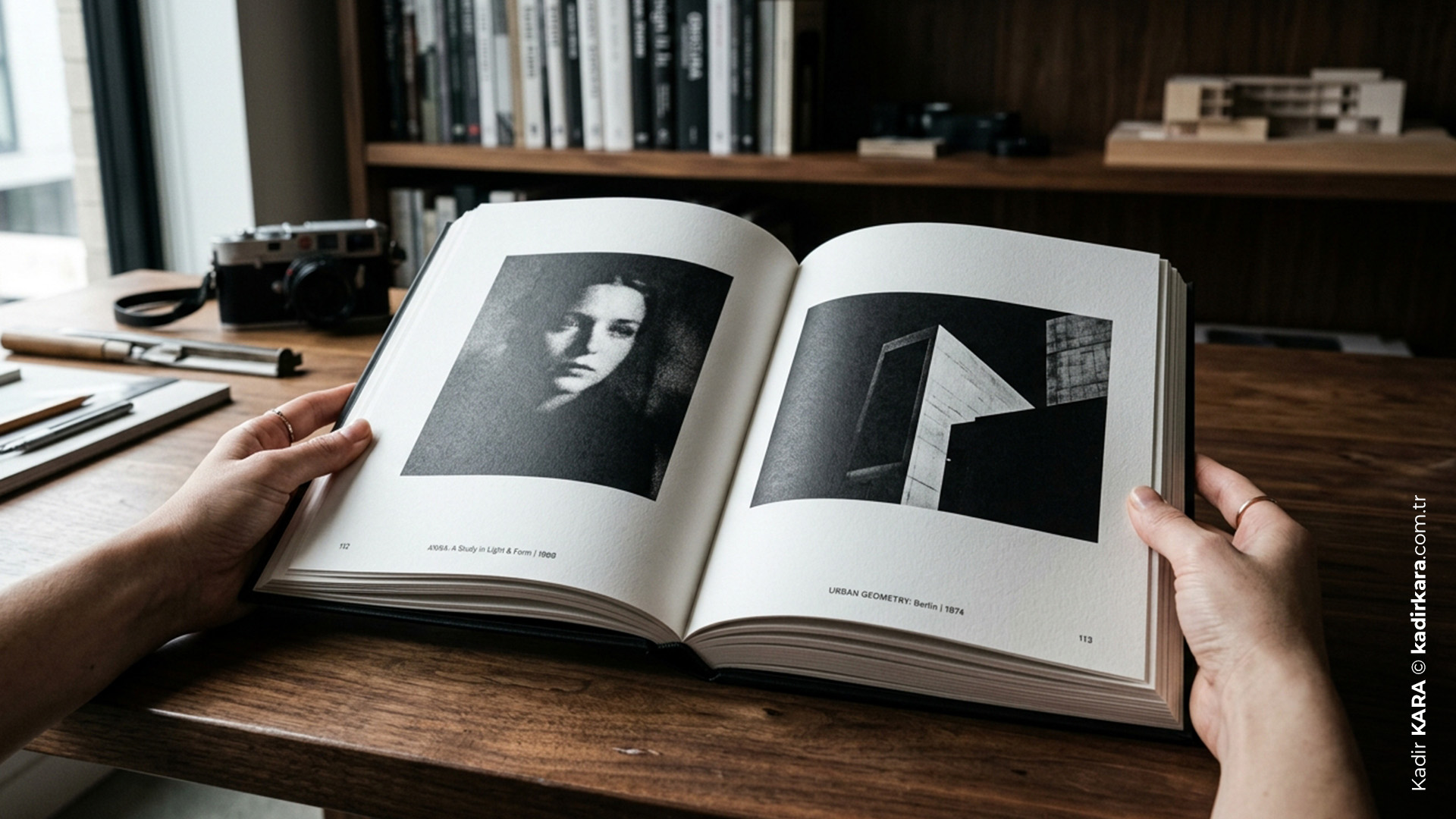
A Photography Book Is an Editor's Manifesto
Behind every serious photography book there is a chain of editorial decisions: what the photographer or editor included and what was left out, how the sequence was constructed, which aesthetic the design chose, the weight and texture of the paper, the printing technique…
The sum of these decisions creates a voice. As you move through the pages of a good photography book, you hear that voice; you sense the presence of a consistent point of view. This feeling is something rarely experienced while browsing a social media profile, because there the algorithm, the platform, and the viewer's attention span constantly interrupt the voice.
A printed photography book, in this sense, is a manifesto. It says: "I believe that when I see these photographs together — in this order, on this paper, with this design — a meaning emerges."
The Logic of Building a Collection
You don't need a geographically large library or an hourly wage to build a photography book collection. A sensible collection can be small but selective.
There are a few practical answers to the question of where to begin:
Monographs: Books covering the work of a single photographer. Dorothea Lange, Vivian Maier, Sebastião Salgado, Rineke Dijkstra… who you choose starts with the names that shape your own field of visual interest. In these books, you see how a photographer looked at the world, and what kind of evolution they went through over decades.
Thematic or Period Anthologies: Compilations that present a particular movement, era, or geography together. These books provide context; you listen not to a single voice but to a conversation.
Selecting by Publisher: Steidl, Aperture, MACK, Hatje Cantz… the print quality and editorial stance of these publishers never fall below a certain standard. If the budget is tight, looking at second-hand books published by these houses is a rational starting point.
Zines and Small Editions: Booklets and zines published in small numbers by independent photographers outside of major publishers can form the most lively and variable part of a collection. These are often more affordable, and over time you'll begin to find them rare.
The core logic of building a collection is this: every book you buy is an expression of a preference. When you look at the books on your shelf, you see a map of your own visual intelligence.
The Photography Book Market: Rare, Valuable, or Both?
Some photography books gain collector value over time. First editions of books such as Ed van der Elsken's Love on the Left Bank (1956) or William Eggleston's Guide (1976) command serious prices today. However, this is not a recommendation to buy photography books as a speculative investment vehicle.
The question of value must be approached on different levels:
Practical Value: Its contribution to visual education, its function as a reference, its role as a source of inspiration.
Cultural Value: Being the documented legacy of a photographer or an era.
Collector's Value: Limited edition, signed copy, or having become rare over time.
These three values are not present simultaneously in every book. But a well-chosen collection always carries at least the first two.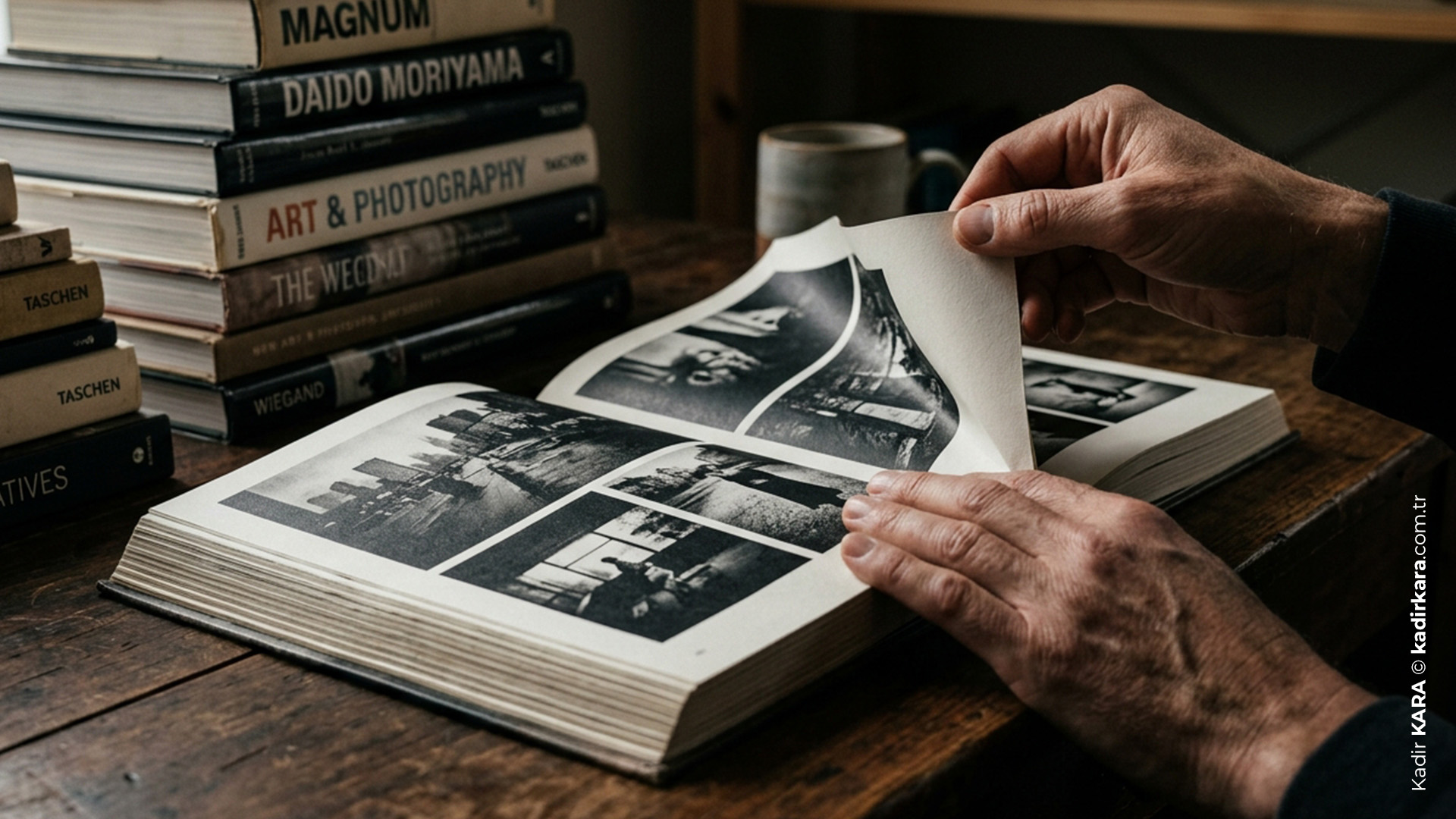
A BRIEF NOTE
I have about ten photography books on my shelf. Most of them are from years ago; I still open and examine them all.
I wanted to mention the number, but then I thought… ten books aren't impressive enough for a decorative shelf photograph — but that's not the point anyway. Most of those books showed me something I couldn't see on a screen. Nobody taught me how sequence works; I understood it because I sat between two pages of a book and asked myself, "why does this feel so right?"
I wanted to write this article because conversations about "photography books" are usually framed either as overly nostalgic (paper is back!) or overly academic (photography and archival memory). Neither is quite right. The value of the photography book is practical: it teaches you to see. That's the whole point.
DID YOU KNOW? - 6 QUESTIONS 6 ANSWERS
1. Why does the print run of a photography book matter so much?
Most serious photography books are printed in runs of 1,000 to 3,000. That figure represents perhaps one percent of a bestselling novel's print run. The small edition stems both from production costs and from publishers knowing that this market is limited but loyal. This is why some books multiply in price on the second-hand market within just a few years.
2. Who becomes the editor of a photography book?
It could be the photographer themselves, a curator, a publisher's editor, or a designer who has worked closely with the photographer for a long time. In truly powerful books, these roles usually overlap: the photographer and editor construct the sequence together, and the designer gives that sequence its form. Robert Frank's The Americans is one example of this relationship; the decisions of Frank and the publisher together determined the book's rhythm.
3. Are "fotoğraf kitabı" and "photobook" the same thing?
Terminologically yes, but in practice the term "photobook" carries a more specific meaning particularly in the art and collecting world: a printed work in which photography is the primary subject, with editorial integrity. The phrase "fotoğraf kitabı" in Turkish is sometimes used in a way that also encompasses books on photographic technique; these two categories are distinct from each other.
4. Is buying second-hand photography books a good idea?
Very much so. The second-hand photography book market is particularly lively in cities like Tokyo, London, and New York. In Turkey, while they are rare to find, serious books occasionally appear on second-hand online platforms. Print quality is generally well preserved; what matters is checking the condition of the book's outer covers and interior. The fact that a book has faded on the shelf does not usually diminish its value.
5. How many photography books counts as "enough"?
There is no right answer to this question, but there is a functional one: as long as you are selective, the number doesn't matter. A shelf of ten books — each one genuinely chosen — is far more valuable than a shelf of a hundred books acquired simply to fill space. The function of the collection is not decoration; it is to serve as a visual reference library you regularly return to.
6. How do I tell if a photography book is "well designed"?
Look at whether the design is getting in front of the photographs. In a well-designed photography book, the typography, paper, and page layout support the photographs — they don't compete with them. If after closing a book you think "the design was beautiful," the design was probably too dominant. If you say "those photographs won't leave my mind," the design has done its job.
Why should every photographer have at least 5 photography books on their shelf?